Friday, April 14, 2006

What Has Religion Got To Do With It 1

What Has Faith Got To Do With it (1)
Religion and The Sanctity of Space of Social Interaction: A Personal Narrative On The Situation In South West Nigeria

(Being presentation at an international interractive session on Religion and the African Society held in Accra in Ghana in 2003).

PREAMBLE
The title and content of this piece have been inspired by a speech delivered by the South Korean Ms. Irene NG, a former magazine editor, who later became a Member of Parliament, at a workshop for journalists in South Korea in 2002. Ms. Irene, in her speech, Walking The Middle Line, which was basically a narrative of her personal experience as a journalist dealing with matters of inter-groups relationships, uncovered some uncommon roots of conflicts among groups of divergent orientations and ideologies. She suggested ways by which a communications worker or any social worker and, by extension, the larger society could effectively navigate the vast and precarious landmine wrought by differences in belief systems as well as cultural orientations, that fill our current social order.
Substantially, Ms. Irene speaks to my experience in various dimensions: as a Nigerian who while growing up and schooling, lived through varied encounters with differing religious tendencies and who, has had to contend with other experiences as a cultural journalist in the past 18 years.
Interestingly, it is in this later dimension that I have come to realize certain basic truths that we, as thinkers and opinion-molders, ought to uphold in our search for answers to the many questions bordering on the survival of our contemporary society(ies). We shall return to these truths later, perhaps, in our conclusions.
But we may stress at this initial stage that the Social Space of Interaction which is that vast field where human beings meet on equal terms i.e as creations with blood and flesh, without the various barriers erected by man and the circumstances of his existence… must be firmly protected by all instruments necessary -- legislative, legal, political, social -- so that it will remain inviolable. It means that the State and its administrators and the people will ensure that even when peddlers of Religious interests including the Entrepreneurs and Profiteers, insist on seizing the control of political and economic powers, they will at least spare the Space of Social Interaction. The Cultural field is the most active of the various fields in the Social Interaction Space and so, we propose that the State must make deliberate attempt to invest in the field so that it could harness its vast potentials of diffusing the tensions that are bound to come with the day to day running of the State and human interactions.
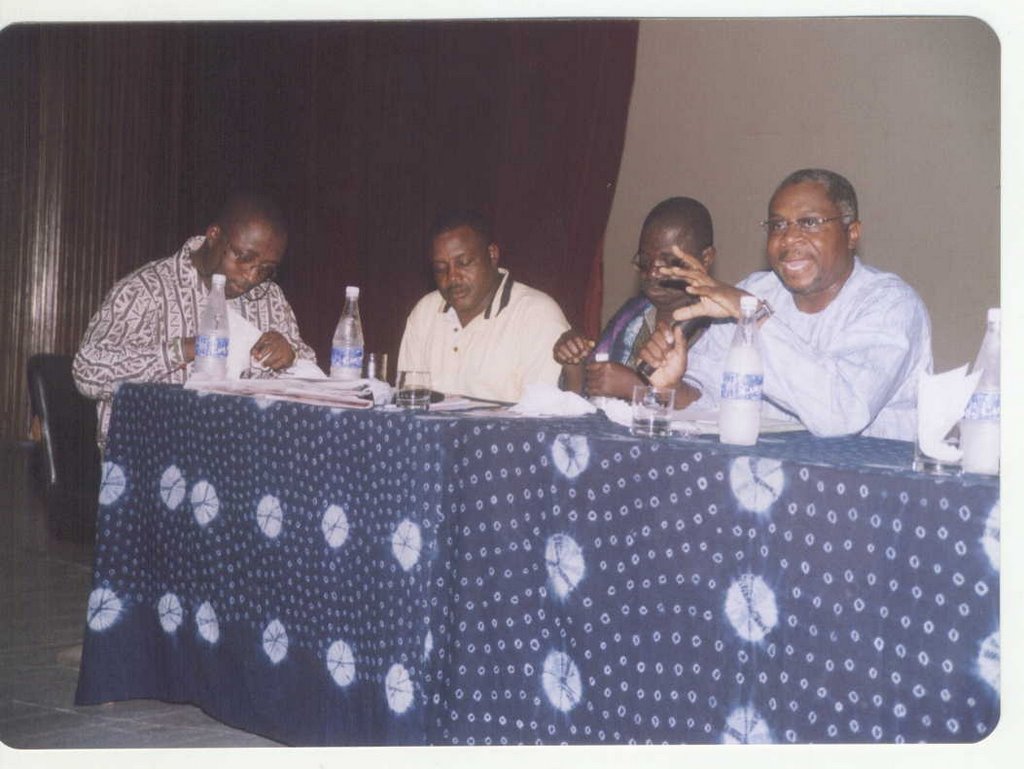
This presentation is the product of a little project began by the Culture Working Committee (an arm of the Culture activist group, the Committee for Relevant Art, CORA, founded 1991) last year after the Colloquium on Culture of Peace that was part of the 13th National Festival of Arts and Culture, NAFEST, in Port Harcourt.
The NAFEST itself had been initiated as the Nigeria Arts Festival (NAF) in 1970 - a few months after the end of the 30-month Civil War -- by a group of cultural intelligentsia of diverse ethnic and religious backgrounds, as their contribution towards quickening the pace of Reconciliation and Reintegration among the various sections of the country that had been fragmented by the political conflicts that led to the war. The festival was taken over by the government after the Second World Festival of Black and African Arts and Culture, FESTAC in 1977. It then became a yearly event though it suffered a break between 1983 and 1988.
At the 2002 NAFEST, the government had included a Colloquium on Culture of Peace as a continuation of an on-going national discourse the best means of resolving the various conflicts that attended the nation's quest for Democracy and freedom from the long Military interregnum.
A group of Cultural Journalists who were attending the Colloquium, perhaps wearied by the unfruitful results of the many conferences that had been held on same issue of finding solution to the crisis and; perhaps also, noting that certain so-called social activists and public commentators had installed themselves as professional speakers at such events thus putting a question on the integrity of their contributions and sincerity of the conferences, had thought of initiating a more practical means of approaching the matter of Peace and National Cohesion.
They thus decided to take up a little project of documenting their individual story with focus on the type of orientation (upbringing, educational and working life) that had shaped their adult perception of life and society, particularly, as it affects the 'Other People'.
The project is in three phases. And the first phase is the production of the Literatures (such as in this presentation), which will then form the basis of some Conferences and Youth-Focused actions in the nearest future. It is our own little way of creating an atmosphere of better understanding among the people and emphasizing on those positive values in our social orientation, which have been upstaged by activities of politicians who masquerade as purveyors of Puritanism and Protectors of God's Lore.
So when we confronted the title 'What Has Religion Got To do With It'? We decided to moderate the sub-text of that theme by adopting the title of the song of the famous American pop star Tina Turner, 'What Love's Got To Do With It'. So we asked 'What Hasn't Love Got To Do With What God Has Created?' The creations we refer to are The Earth and its Human Occupiers.
This presentation will oscillate between the personal narratives and the cold facts of historical antecedents as they relate to the topic and particularly, the experience of the South West of Nigeria.
****
NIGERIAN POLITY AND ETHNO -RELIGIOUS BALANCING
Ethnicity and Religion have always dominated discourse in Nigeria polity. These same issues have also, always been prevalent in the many conflicts that Nigerians have experienced in the past decades.
Governance of the country has been largely influenced by ethnic and religious considerations, particularly since 1914 when the 'geographical expression' that is today known as Nigeria was contrived by Britain, the former colonial administrator or 'master', from the Northern and Southern Protectorates.
Activities of consecutive Nigerian governments particularly, in the sharing of political largesse, have always placed emphasis on where the beneficiary comes from and the religion, which he/she professes. Similarly, the composition of Federal (as well as some state) cabinet has always been sensitive to balancing of the various ethnic and religious divides, although one can say that for religion, the contention is always between Islam and Christianity.
The Traditional Religion practitioners who are said to account for about 60 per cent of the over 120 million population, are always excluded except when there is a major rupture in the religious world of the nation and they are called upon to join their Muslim and Christian fellows to proffer solution to the crisis. Perhaps, the first major attempt to include the traditional religion in the national agenda was with the recent appointment of Professor Wande Abimbola, a renowned Traditionalist and Culture Scholar, into the Federal cabinet of President Obasanjo, as Special Adviser on Culture and Chieftaincy Affairs.
Throughout its political history, the composition of the Nigeria Federal Executive Council has always respected the Islam and Christianity dichotomy. At independence in 1960, Dr. Nnamdi Azikiwe, an Igbo Christian was elected the President while Alhaji Abubakar Tafawa Balewa, a minority-Hausa Muslim was Prime Minister.
In 1979 during the Second Republic, Alhaji Shehu Shagari, a Fulani Muslim was the President and Dr. Alex Ekwueme, an Igbo Christian, the Vice-President.
Although the 1983 Presidential elections paraded two Muslims (MKO Abiola and Babangana Kingibe), one, a Yoruba and the other an Hausa on the ticket of the SDP, the issue of religion was topical particularly, in the campaign of the second party, the NRC.
The present dispensation since 1999 when the country re-adopted democracy follows the same pattern with Chief Olusegun Obasanjo, a Christian as President and Alhaji Abubakar Atiku, a Hausa Muslim as Vice-president.
But the dream of the founding fathers had always been a land of equal opportunity. As a matter of fact, the dream to have a pluralistic society where every component -- every people and every individual -- is free to adopt, develop and practice its (his) own faith and set of beliefs -- is well entrenched in the consciousness of virtually every Nigerian. And indeed, certain national policies are founded on this dream and aspiration of mutual respect and, accommodation of, for interest of other people.
For instance, the Second National Development Plan -- which has come to be known as the most definitive of the various Plans (that have always been abandoned at birth in any case) -- stressed five key objectives of the nation. These are to build:
oA free and democratic society
oA just and egalitarian society
oA united, strong and self-reliant nation
oA great and dynamic economy
oA land of bright and full opportunities for all citizens
However, these objectives have been abused and manipulated on many occasions by those whom Ms. Irene had described as Religious Entrepreneurs but whom we have also identified as Politico-Religious Merchants and Profiteering Puritans, who capitalize on the gale of social and economic depression that have over the decades, unleashed strain - physical and spiritual -- on the people.
The activities of these selfish leaders and opinion molders have also over time, managed to have some degree of backing by the corrupt tendencies in the State as well as the profiteering 'Big Brothers' from abroad.
The institutionalization of these Fifth Columnists in the affairs of many African states, in particular here, Nigeria, has led to the advent of frequent religious crisis.
It wasn't until the 1980s that cases of very serious religious intolerance and violence started showing up in Nigeria polity and; though widely reported (because of their novelty), they were mostly isolated cases. The 1990s brought the most damning of the crisis in the infamous Maitasine Riot -- a Muslim sectarian conflict that was promoted as inter-religious crisis and which rocked the nation to its foundation.
But we must note that the 1990s recorded the most disruptive events in the political and economic lives of Nigeria. The Second Republic, which was the country's second romance with Democratic Governance, was annulled in 1983 by the Military adventurists (politicians) who had halted the First Republic in 1966.
Also and very significantly, Nigeria took the International Monetary Fund, IMF loan in 1985 and launched the strangulating economic regime of Structural Adjustment Policy, SAP, which of course, sapped hope, confidence and self-esteem from the will of the people to live and survive.
Thus the wave of aggression that enveloped the national spirit can be gleaned from the perspective of economic emasculation of the populace and the dislocation of the political movement of the country. This aggression and sense of disorientation did not spare the religious conviction of the people. It buried anger in their souls and hatred in their senses.
****
NIGERIA AND THE SOUTH WEST
Nigeria is usually divided into three rough zones - North, East and West. Each of these zones portrays the two major religious tendencies of the country. The East (including the relatively new branding - the South-South), is largely Christian while the North is predominantly Muslim.
The West, however, is almost evenly divided among the two. In fact, there is hardly any family in the West without some of its members who do not share sympathy for either of the two main religions - Islam and Christianity -- even when the main family professes to either of the faiths.
The dominant ethnic group in the West is Yoruba and they are largely cosmopolitan and liberal in social, cultural and even political orientation. And there are shared fundaments between the traditional norms and the so-called Modern influences.
****
RELIGION OF THE YORUBA
Defining the religion of the Yoruba has always been a subject of contention among sociologists and other classes of researchers. Certain hasty conclusions had said at some point that it was Paganism and they based their resolve on the preponderance of perceived cultic influences in the norms and cultural practices of the people.
But this only signifies the problem of Labeling, which goes beyond mere categorization. The term is often used derogatorily by the adherents of the two main (foreign) religions who perceive themselves as the 'authentic' or 'righteous', to express their subjective conviction of the 'Other'(s).
Paganism is no doubt, a convenient choice of label or perspective by Muslims and Christians for a set of beliefs rooted in the culture of the people and, which they cannot understand or have refused to comprehend.
However, one point on which they all agree is the fact that there is the sacrosanct place of the Supreme Being who occupies the same status as God in Christendom or Allah in Islam. All power flows from the Being and he dispenses his authority through the various deities, who other researchers have defined as similar to the various prophets in the other religions.
Also, debates have been had on whether Yoruba religion could be seen from the perspective of Monotheism - i.e. because of the Central place of the Supreme Being; or Polytheism i.e. because each of the deities also occupies important place of worship in the pantheon.
However, Bolaji Idowu, in his landmark 1962 publication, Olodumare - God In Yoruba Belief (Longman, 1962), contended that:
"It is rather dubious if we could speak of the religion of Yoruba people in precise term. What we have seems to be a mixed bag of individual cults out of which everyone chooses according to lineage or family tradition, or as the circumstances of life dictates. Nevertheless, the one big Bag which holds the individual cults together, is Olodumare (also Oluwa, Olorun etc).
This suggests a pantheon in which Olodumare is one among many... He is a part as wholly. His relationship to the divination being that of “the sovereignty by which He orders His dominion in which they are included”. And none of the deities operate its power and will without the direction and supervision of Olodumare.
Generally, the Yoruba attitude to religion is one of tolerance and moderation, hence the title of any Oba as 'Baba Ilu' i.e. father of all. An Oba is expected to attend all religious activities in his domain, be it of Christian, Muslim or indigenous colouration. Indeed, there are certain Festivals which mandate that the Monarch must be a father of the entire community and that irrespective of his Religious inclination, he must be part of the spiritual comfort of the people as expressed in their Festivals as well as other social functions.
We have the Osun Osogbo Festival in Osogbo, Osun State. We have the Olojo Festival, in Ife also in Osun State. We have the Eyo Festival in Lagos. We have the Ekimogun Festival in Ondo State; We have the Okebadan in Oyo State among others. In each of these places, the Monarch is either a Muslim or a Christian but he still has to be the 'father of all' by leading activities in each of the national festival or ceremony in his domain.
Recently, some Obas who refused to respect this doctrine of being a father to all in the community have faced problem with the community.
Some studies have suggested that the Polytheism undercurrent in Yoruba religion coupled with the cosmopolitan nature of the people accounts for the attitude of accommodation of the two religions with little room for conflicts. But this accommodation has always discomforted the people of the two other religions who insist that the commitment of a Yoruba person to a religion is suspect. For instance to most Muslims in the North, the Muslim in the South is a 'kaferi.'But the fundamental of the Yoruba to religion is borne in the song :Awa Osoro Ilewa
Esin ope kawa masoro
Awa o soro Ile wa
****
Religions apart, people of the southwest are mostly driven by the virtues of kindness, love, tolerance and humility.
Consciously or unconsciously, they could be seen to have hearkened to the submission of the Holy Qur'an when Allah says: “Oh Mankind! We created you from a single (pair) of a male and a female, and made you into nations and tribes, that ye may know each other (Not that ye may despise (each other). Verily, the most honoured of you in the sight of God, is (he who is) the most righteous of you. And God, Has full knowledge and is well acquainted (with all things).
YORUBA CONTACT WITH FOREIGN RELIGION:
Whereas, Bolaji Idowu stated that it is difficult at the moment to say exactly when the two religions first made their contacts with the country, their coming is bound up with the early history of the Yoruba. J.M Groves speaks of Christian missionary activities of the Portuguese and of the Spanish in the Benin Empire between 1485 and 1655. Also Encyclopaedia of Religion and Ethics notes missionary activities in Benin, Angola, Upper Volta, about same time. Benin is only 180 miles away from Ife the cradle of the Yoruba.
Christianity came again in 1841 through slaves who were liberated in Sierra Leone.
It is difficult to put a date on the entrance of Islam into Yoruba land, but if we consider the fact that many of its neighbours like the Nupe, the Madingo and Hausa who trade extensively with Oyo people received Islam by the 10th century, it is certain that the northwest of Yoruba land must have some Muslims as far back as the 11th or 12th century. However, A.D. Bivar and M. Biskett in the "Arabic Literature of Nigeria: A Provisional Account" (BSOAS, XXV, 1962) and; H.F.C. Smith: "Arabic Manuscript Material Relating To The History Of the Western Sudan", made reference to Yoruba Muslims in the 17th century.
Christianity however, helped to further reinforce the Yoruba's belief in a supreme life and human responsibility.
Islam, which was also recorded to have come through Sudan via Northern Nigeria also help to reinforce such values as pre-destiny and fatalism. Islamic fatalism - the will not to question the will of the Supreme Being.
****
But the two religions have had a weakening effect on Yoruba's belief system. The Yoruba religions have been known to suffer immeasurable disruption through intervention of the two religions. Stated Bolaji Idowu: “Besides the internal weaknesses which makes for its retrogression, the religion of the Yoruba has been affected by the incursion of two world religions - Christianity and Islam - which came into the country with their attendant culture.
****
But we race ahead to another of conception of our conclusion that the insulation of Yoruba communities from religious conflicts, the volatile dimension of it, as had often been witnessed in other parts of the country, is rooted in the fact that the Yoruba culture in the context of its socio-cultural milieu including its norms and practices, has been able to contain the excesses of the two foreign religions - Islam and Christianity. Whereas it has managed, even where they in their philosophical contentions have gone against its foundational principles, to accommodate them, it has maintained its sacred doctrines of love, brotherhood and tolerance of all shades of opinion.
****
However, we should not be under any illusion that the Yoruba culture and by extension, religious conviction from future conflicts or clashes with the foreign religions. As a matter of fact, we have noticed the aggression of the newer forms of Islam and Christianity 'to fish' for their 'new men' from the vast seemingly unexplored traditional religious fields to which the Yoruba religion is often confined. The Evangelisation or what has been termed Missionarism principles of the younger sects of the two main religions are bound to sooner or later run into conflict with the liberal contentions of the Yoruba cultural norms. Already we can see the manifestation of this future conflicts in the activities of the Gospeller cults of the two main religion which thrive on condemning or derogating the existing beliefs or practices to legitimize its own convictions or justify its own existence.
Thus we have in the South West, we have the rise of a new (militant?) gospelling Muslim body called the NASFAT which is redefining the traditions of Islam worship of Muslims. Its members now worship on Sundays at about the same time that the Pentecost Christians mass for worship in their various churches. Besides, the NASFAT is exploring the Pentecosts' norms of tele-evangelism. It is thus curious when on Sunday mornings, young Muslim clerics come on the television screen preaching the gospels of Islam. They even stage Praise and Worship in the established Christian practices. And the famous Lagos-Ibadan Expressway which has in the past few years been colonized by Christian movements of Pentecost persuasions has suddenly become choice spots for the establishment of worship centre by the NASFAT. In other words, there is Jihadist colouration to the practice of the new Muslim movement and it is easy to project that the next Religious conflagration may actually come from the seemingly Conflict-insulated South West… and it may just begin at the Lagos-Ibadan Expressway.

Spirit of the Artist 3

THE DANISH CARTOON AND THE NIGERIAN CARNAGE
On cartoon and Bigotism
By Niyi Osundare
"Tell me, Niyi", enquired a worried American
colleague who ran into me in the long corridor of the
English department here a couple of days ago, "why all
these terrible killings in Nigeria over a cartoon
published in far away Denmark? Since I heard that
horrible news yesterday evening, you and your country
have been on my mind. But I just can’t figure out any
reason for the killings in Nigeria!. . ." I thanked my
colleague who, only the previous day, had, in that
same corridor, given me a warm embrace and fortified
me with kind words in full commiseration over my
Katrina calamity. She had talked most concernedly
about the frightening circumstance of losing one’s
library, and offered me free access to her book-stock
any time I needed a book she might have.
I walked quietly into my office, and sank into
the chair like a sack of lead. For a painfully long
moment, my Katrina-begotten woes faded into a corner
of my consciousness, as the freshly reported massacres
in Nigeria assumed center-stage, and the drama of our
country’s fatal stupidities unfolded before my mind’s
eye. I was still in the grip of this negative reverie
when another enquiry arrived, this time in form of an
e-mail from a European media acquaintance who wished
very earnestly to know the underlying reasons for the
recent mayhem in Nigeria, and the links, if any,
between these incidents and the violence in the Niger
Delta. In a manner of speaking, my two colleagues
jolted me into another harrowing contemplation on the
so-called Nigeria project.
Nigeria is an accident waiting to happen. The
house that Lugard built for the glory of British
imperialism has creaked in every joint since the
Amalgamation of 1914. I have always wondered whether
the British actually conceived Nigeria as a permanent
nation-state or some bogus contraption knocked up for
the satisfaction of ephemeral imperial interest.
Unlike many of the European countries which had the
chance of fumbling through different stages of
political and social evolution, and whose eventual
composition took long and rigorous processes of
constitutional engineering, Nigeria (like nearly all
other African countries) was promulgated into
existence with little or no regard for its ethnic and
religious peculiarities.
This "gathering of the tribes" as the prescient
Soyinka tagged the nascent state in A Dance of the
Forests way back in the late fifties, has really never
known genuine political integration and social
cohesion. To put it rather bluntly, Nigeria as it is
constituted at the moment, is not a nation. Its claim
to countryhood is even in doubt. There are too many
cracks in the wall of the Nigeria house; the windows
are askew; the doors do not know where to stand; the
foundation is a mix of quicksand and quagmire. Because
its imperial architects were self-serving and
disingenuous, and its native contractors (past and
present) are short of integrity and vision, the
Nigeria house has really never stood with all its
parts in place. A gruesome civil war brought that fact
fatally home between 1967 and 1970. But as must be
clear even to the blindest observer of Nigerian
affairs, the civil war neither ended in 1970, nor did
the welter of factors that brought it about in the
first place. Below the ostensibly cool façade of the
Nigerian landscape, there is always a crisis
simmering, rearing to erupt. The triggering factors
are usually ethnic and/or religious. Always, a lurking
trouble in the house.
And so, back to my American colleague’s question:
how could an offensive cartoon published in far-away
Denmark have resulted in such mindless mayhem in
far-away Nigeria? Two major points are competing as
answers to this question: one, the rickety,
crisis-prone condition of the Nigeria state; and two,
the nature of the two so-called world religions, with
the "jealous" God they proclaim, and the violence of
their evangelism. For, let’s face the fact: neither
Christianity nor Islam can lay claim to any innocence
in the annals of war and waste, of madness and mayhem
that have afflicted Humanity in the last two
millennia.
Sanguinary crusades have traded places with gory
jihads, the blood-letting in each case purportedly
done in the name of God. These two religions have
affronted Humanity with the blatant contradictions
between the theory of their credo and the actualities
of their praxis. For instance, both claim the God they
worship is a God of peace, but we are left to wonder
why they routinely wage wars, destroy human lives and
property in a bid to win adherents for that God. If,
as they preach, all human beings are God’s children,
and all human lives are precious, even sacred, how can
fundamentalists hope to please God by destroying those
children, those lives? Does anyone really see the
fatal oxymoron in the term "holy war"?
I, nobody else. My Self, no Other. My way, no
other way. I am the only source of salvation; all
other sources are routes to perdition. The only key to
heaven/paradise/ is in my keeping.. . At the very core
of monotheistic religions is the seed of a
self-absorbed, self-seeking, self-propagating,
other-negating creed of intolerance. Zealotry is its
basic principle; evangelism its roaming rubric. Not
for the fanatic the universal credo of
live-and-let-live; believe-and-let-doubt. Not for
him/her the inevitability of anti-thesis in the
running dialectics of human ontology and its
mechanisms of knowing and believing. But the rules of
Nature and the rainbow order of universal practices
run counter to the zealot’s monochromatic
perspectives. For Nature manifests itself in a
diversity of phenomena, a myriad of mutations, a
battery of nuances and grey tonalities, a polyphony of
voices. Whatever idea exists only on the basis of
self-reproduction and self authentication soon
stagnates through in-breeding, or ends up in
narcissistic internal combustion.
The Yoruba understand this in all its intricate
ramifications. Which is why one of the most prominent
aspects of Yoruba worldview is pluralism: Ona kan o
wo’ja (Numerous roads lead to the same market); "Mee
l’Oluwaa wi" (Many, says the Lord). In the Yoruba
perspective, the sky is wide enough for a thousand
birds to fly without colliding (unless some of them
decide to be unusually greedy). The availability of
alternatives, the possibility of preference, the
matrix of choice, are all vital aspects life and
living. These and other optative parameters
contribute significantly to the human power of
discretion, his/her will to freedom. Since you can
never choose between one thing, the absence of an
alternative negates the principle and possibility of
choice. That absence institutes the tyranny of the
monolith and the violence of the sole-supreme. The
destruction of the Other invariably leads to the
nullification of the Self.
Any wonder, then, that the Yoruba spiritual world
is populated by a pantheon of deities, useful,
secular, anthropomorphic, existing in keen and
intricate complementarity among themselves and close
communion with humans beings. This liberal attitude
informed religious practices in many other indigenous
African societies that come within the compass of my
knowledge. Of course, through a sustained and vicious
process of deliberate misapprehension and
misrepresentation, both Islam and Christianity
demonized the liberal, accommodationist ethos of
traditional religions and used their enormous military
and political powers to suppress their pluralist
philosophy, then imposed their own "civilized"
mythology of the "one and only", the jealous
Sole-Supreme. The scramble for the soul of the
beleaguered African by these two religions has been
the source of much of Africa’s woes. To the best of my
knowledge, there were no religious wars in Africa
prior to the momentous advent on the continent of
these rival Juggernauts from the Middle East.
And now back to Nigeria, and the recent religious
"wars". Observers and commentators have wondered why
an offensive drawing by a Danish cartoonist, published
in Denmark several weeks ago could have generated so
much furore in Nigeria, resulting in the deaths of
hundreds of people and the burning of numerous
churches and mosques, and the gross undermining of
national security. After all, no mayhem of that
proportion was precipitated in Saudi Arabia, Islam’s
ancestral home. Why has Nigeria, an outsider of some
sort, wept louder than the bereaved?
As I hinted earlier on in this piece, the real
causes of the recent crises in Nigeria go beyond the
Danish cartoon (though it must be emphasized that by
itself, that cartoon is insensitive and quite
provocative). Those familiar with the history of
Nigeria will notice the chilling familiarity between
these crises and the ones that immediately preceded
the Nigerian civil war. Only this time around, the
killing of Easterners and the destruction of churches
and business in some parts of the North have exacted
reprisal killings of northerners and the destruction
of mosques in some parts of the East. A dangerous
tit-for-tat policy is here; an ominous
an-eye-for-an-eye warfare that, if not addressed
appropriately, may hasten Nigeria into blind
disintegration.
The signs are already there in the spawning of
such organizations as MASSSOB (Movement for the
Actualization of the Sovereign State of Biafra), OPC
(Odua People’s Congress), the Arewa group in the
north, and the countless, intractable militias of the
Niger Delta. At no time in Nigeria’s history have the
campaign for self-determination and cry against
marginalization been more multi-pronged, more
blatant. Nigeria’s federalism, which has never enjoyed
any measure of sound health, is showing signs of
serious strain and a potentially fatal fatigue.
Unfortunately, the country’s rulers do not seem
to be able to read the proverbial handwriting on the
wall. Consumed by their money-grabbing, vote-rigging
addictions, they are "too busy" to notice the cracks
in the wall of the Nigeria house, and the festering
disaffection of the people who suffer under their
misrule. Right now, the President of the "Federal"
Republic of Nigeria is too preoccupied with scheming a
constitutional amendment that would extend his term in
office. He is busy rewarding supporters of that
stratagem and punishing those audacious enough to
oppose it - a maddeningly manipulative act that has
further polarized an already fractitious country.
Can’t President Obasanjo see the link between his
toxic ambition, the mass poverty in the country, the
skewed structure of the Nigerian "federation", the
guerilla war in the Niger Delta, and the alarming
spate of the recent massacres? With luck, we may be
able to douse, this time, the conflagration sparked in
Nigeria by the Danish cartoon. The fire next time may
defy all effort at extinguishment.
Niyi Osundare, March 5, 2006. Osundare is poet and university teacher
• First published in The Guardian Lagos

Spirit of The Artist 2

The Artst In The Society

Tuesday, March 21, 2006 at 5:32 PM WAT
A Love Affair With Daddy Showkey
By Olaiya 'Subomi
My friend James barges in this afternoon, visibly agitated…
"Why, you guys don't give Daddy Showkey and the guys from Ajegunle the respect they deserve; you don’t even put them on your pages? You are biased and segregationist…"
The activist poet raves on. And when he goes like that, you'd better hush him.
"But where did you pick up all these accusations", I launch at him, a bit irritated at his incorrigibility.
"I don’t have to pick it up from anywhere. I read your pages. When was the last time you wrote something about Showkey? Even when he won four award including best song and the best musician in the country award, you only mentioned it in passing. That is not good. The guy is great and he deserves more than you are willing to give him!"
James drops into one of the seats before me, dives into the bowels of his bag clawing at some object. I observe him: such an intelligent fellow but sometimes, lousy with his reasoning; and a running mouth to boot. Perhaps he talks before he thinks. But then his word sparks a thought in me:
Have I really being unfair to these new age Nigerian musicians who peddle their wares as afro-hip-pop and see themselves as culturally more exposed than the musicians in the traditional or trado-modern forms such as juju, fuji, highlife, kalangu, ikwokrikwo among others.
Well, to credit, the new wave musicians (mostly singers in fact, as they hardly play any instrument) have succeeded a lot in wrenching a great deal of space from the hitherto tight clutches of the local airwaves and screen by the Western (American) pop works.
The radio stations for instance, now find themselves playing more of Tony Tetuila, Azaadu, Remedies, Plantashon Boys, Zakky Adze, Maintain, Eedris… The more reggae steeped of them run the Showkeys, Father U-Turns, Fryos, Mighty Mouses on their various programmes.
This is a great cultural statement indeed. At least, a Westerner would not any longer, step here, listen to local FM stations and, ask if he was back in his homeland. That used to be the case and it happened in 1998 to a group of American journalists on a research mission here.
And of course, in a time of economic depression and political uncertainties buoyed by social disequilibria, the hip pop acts have provided entertainment for the distressed and liven up the stressed social space. They have found jobs for themselves and others in showbiz fields such as audio-visual, dance, designs, fashion, even marketers and others. They might have even re-coursed certain potential miscreants from the landmine planted on their path to future by massive graduate unemployment and youth disempowerment.
Daddy Showkey!
Now, I am thinking: James must be running a PR consult for the sensational reggae toaster from the seedy suburb of the Lagos metropolis.
In fact, hasn’t Showkey got more than he deserved from the critical press?
Sure, he is a dance floor favourite and knows how to waoh the popular concert arena, but he is very light in concept and vision…
Well, this is my (very personal) critical opinion. After all, some other supposed critical media workers had once blessed Showkey's head with the best Nigerian Musician for 2000 crown.
Yet this is where I think the problem is: Status Conferment.
There ought to be a debate on such ritual. Who for instance, should be confirming status on the Nigerian artists? What are the criteria to hook on? Should the venture even be the turf of some media workers who are not trained in music…? A legion of queries to be raised.
There is a violent misplacement of values when the wrong people have the wholly whim to give sensitive endorsement to certain artists and, for indeed the wrong or suspect reasons. Wrong signals may be sold to other more culturally civilized observers that we are a people governed by the masturbation syndrome; rather than the cerebral.
Showkey as the best Nigerian artists. Curiouser and curiouser!
"Oh well, he probably sold better that year, had the most frequent radio and TV airing, had more concerts bla bla… But was he really the most qualitative voice, best tuned musician, most sonorous singer, eminent lyricist, most philosophical composer… what in fact is in Showkey's songs to balm the pain of the hopeless, and satiate the discomforted with dose of tonic…?"
James springs to life again!
"There you are! I knew that you don’t know much about the guy. You have not been listening to him, because you are biased…he is a fighter for his people, the ghetto people. You won't know that because you are one of the oppressors of the suffering masses, the type in Ajegunle…"
Were James not my friend, I should have called up my lawyer to start preparing for our million-naira days. Such lousy accuser!
"Well James", I begin, "I can't really think of any great, deep work from that chap. He is a good performer, he even created the dance style, galala, but that is where it ends. As for lyrical depth, he is nowhere. As for singing, the voice is haughty. And his act though comical and so deceptively attractive, is in material and substance dirty. It is the stuff of the crass. Best for 'area boy-minded' fellows and…"
" See where you sell yourself in the open market" James shoots, "you mean you have not heard of 'Fire Fire In our country, give me plenty water make I quench fire'. James is singing. I am amused…
"Okay, give me another one".
" There are many of them… 'Fire Fire, In The Ghetto', said James and he dries up. I tease him"…Dianna, Welcome Daddy Showkey…"
He sure got the joke and cast his eyes away from my mischievous looks.
I lecture him: "You see there are populist artists and there are visionary artists, just as you have populist politicians and philosopher—politicians.
"The populist artist is the more popular because he appeals to your basal instincts, more to your brawn and purse, your dancing feet and your sexual desires. The Artist-philosopher steals your souls with his words and tune. He conquers your space of reasoning; he imprisons your emotions and overrides your cerebral cavity so much that you fall in line with his thought process.
"That is the artist that moves men to positive actions and speed up the process of change. He is a medium of national reformation or cultural regeneration. He is the one to spur a renaissance in the social consciousness.
"Your Showkey is not that kind of artist and neither are other artists of his ilk. They just want your pocket and your patronage. That is why their music go well with drinks and women, especially the easy virtue type".
Poor James. He gazes like rain-drenched chic…
I continue: "Of course, there are some of those Ajegunle artists who have come up very strong in terms of deep lyrics, even if flippant or perfunctory… I talk of Mighty Mouse, even Showkey and his good friend, Daddy Fresh…
"But the most surprising has been Baba Fryo who, curious still, has about the most unserious personal carriage of them all, with his usual one-eye mask. His Denge Potze debut happens to have approximated the rot in today's social etiquette and valuation system where a man's worth is no longer judged by the quality of his mind and resourcefulness of his handiwork, but by the flashiness of his appearance.
"You are only as big as the size and brand of your car and the depth of your intellect could sometime be your passport to public opprobrium. Your fat certificate can no longer earn you applause in your community.
"The ideal role model most parents sell to their children, is that chubby-cheek fellow from the city with a limo and an obscene bank account and grand house down the street. It doesn’t matter to such parents that to the vacuous fellow education is an anathema; or the volume of blood he shed to grab riches by the scruff.
"Fryo studied this new attitude and came up with Denge Potze, a treatise on the ignominious crash of values and morality of the new society. He follows up with Notice Me, which in content and context is a stretch of the message in the first.
"Now that is a popular artist who managed to scale the bar to the midst of philosopher-artists. And it doesn’t really matter how clean or astute the content of his message is. There are some of them like that too, even Daddy Showkey in some of his songs; except that his extraneous are sometimes too much that they tend to overshadow the substance."
I have a student in session, so I continue to pound ideas into James’ head:
"Popular art is a luxury to a society such as we live in, bedraggled by political iniquities and consistently raped (sorry, ruled) by mean men whose idea of leadership is underdeveloping their community and decimating their people to the deep of the abyss.
'In such a society, a real artist would not just be an entertainer doing the lewd and seedy songs that can only administer temporary relief to the people.
"The artiste will no doubt, find himself drawn into the debate about reordering the status quo; sculpting a more focused leadership and an enlightened followership -- he will indeed champion the struggle of his people, his potential fans, to get out of their precarious situations.
"Otherwise, he might find himself inadvertently as the harbinger of further fatal resolve on the part of the people. For one, the insincere note in his songs could breed false hope in the people to the point that they begin to resign to their fate and weaken their desire to fight their way out of their situation; and that is cancerous to the heart of the society and the psyche of the people themselves.
"That is the kind of thing a Showkey or those in his group who have the opportunity to talk but have decided to hum, could end up achieving".
I didn’t want to lose James, so I hit further: "Showkey is even fair. There are far more educated musicians whose initial pedigree was committed art, but who soon capitulated to the force of commerce that they abandoned the serious for the mundane and; they even have the audacity to proclaim in the market place their new found penchant for 'na ideology we go chop' attitude.
"It is okay if an artist wants to chop, afterall it is in our cultural canon that 'a man eats where he sweats' and; besides, it is a matter of personal choice. The problem is: once you sentence yourself to 'chop chop' syndrome, you may discover that you are not able to get out of it again. 'Money good o, but money make man lose im soul, money na devil', sang Nico Mbarga… and that is what has afflicted majority of our musicians.
"And the pain is that most of the legends that they peddled as their mentors were not so given to flirtatious swing between the profound and the mundane. That was why they were able to create the evergreens, works of lasting virtues that you and I still coveted today", I submit.
"But all the musicians cannot be politicians or fighters. Life is not so dry… people have to live and love", a rasped James has finally found his voice. Wonderful!
But I am not done yet.
"Oh yes, they don’t all have to be. But each artiste has to be evaluated according to the nature and colour of his vision.
'If your vision is as deep as the hollow of your stomach or as vast as the space of the dance floor, why should any self-worthy critic accord you a deeper minefield of idealism or ideology?
"If you battered your artistic conviction for a pot of commerce and survivalism as some notable artistes here have done, why should a critic continue to ascribe to you the golden garb of the committed, when you have long abandoned the ship? And if you on your own, declared yourself no longer interested in making your art serve far more missionary objectives, why should the public continue to proclaim you as their voice of reason and wisdom?"
"Well, you are right", say James, but I was not convinced he got the message yet.
"You are a poet", I say, "If you write show your colour, konko below or omo pupa lemi nfe kind of poem, why should you be taken beyond the reach of your vision. That critic would have committed a faux pax, you know. And if you decided to capitulate into a socially conscious artiste to a mere entertainer, undistinguishable from the runs of the mill, why should I be expected to rank you alongside your colleagues who are futuristic and doing profound works? That is the crux of it all."
"How about those guys doing all those great stuff on rap and toast?" queries James, "I think you guys should look at them closely and see which among them would endure. They can't all be flukes!"
"Well, remember I said it too that they are fulfilling a role. They have for one, forced our exuberantly Americanized deejays and presenters to detune their selections a bit. Now you either have to play the local varieties of the Western pop or you are off the beat. Thanks to the doggedness of Kennis Music and the like who have taken those local boys to greater heights.
"But you see, you still cannot define authentic contemporary music of Nigeria from the musical products of those guys. What they are doing is cooking western delicacy with spices of local condiments. The taste can never be as real as the real indigenous menu. At best, especially to a foreign hear, it will sound like a well-grilled mistake, irritable but passable for unserious attention.
"Those of them who stretch their imagination further in terms of sound experimentation and style and identity would surely survive. And in fact those are the guys who seem to be doing something akin to evergreen. Maybe a Paul Play Dairo, whose real luck is that he adapted an already evergreen number of his father, IK Dairo.
The products of the hip pop guys are like tomato, highly perishable. If you don’t consume it soonest, it goes rotten. That is why you see them always rushing back to the studio -- to keep themselves in business.
"Imagine in a recording career of less than two years, some of them have had as much as eight albums. That is not the stuff of professional musicianship. It will sound ludicrous in some more musically enlightened clime.
"Really, I think many of those guys should team up and do one solid, serious work. You know the way, the Spice Girls did. And long before them, the Supreme Sisters that eventually threw up Dianna Ross. Or ABBA. Or Beatles. Or Rolling Stone. Or…
"Won't you for instance say that the Remedies would by now, have been a more enduring group but for the solo career ambition of Tetuila, Idris and Montana? The Plantashon Boyz remains hot because they are in some kind of a cooperative…
"But many of the guys just feel that they could croak into the Mic and get the studio engineer to strewn it up into some manageable sound and, pronto, they are in the market.
"Of course, after some cash-induced rash of radio and TV exposure, they crash off the sight and mind of the public. They have to hit the studio again. The music is two-for-kobo".
Now I am sure I have lost my boisterous friend, James. His gaze is fixed hard on the TV screen. Whatever was of interest there? The usual: suicide bombers have wreaked another havoc; this time in downtown Jerusalem; there was blood and pandemonium everywhere on the street.
I grab the remote control. There! The petit singer, Yinka Davies, doing Eko Ile, a one-off video clip promo she did long before her current album was released.
"Yeah, that is what I think a real musical effort is", I announce gleefully. "You could see some grand effort at quality performance".
James isn't listening but I continue, "now would you compare this with Showkey. Or would you put Showkey in the class of Kayode Olajide, Laitan Adeniji, Funso Ogundipe, Kola Ogunkoya, Seyi Solagbade and others…"
James retorts dismissively: "Many of those guys are only imitating Fela, they have nothing original to offer!"
There we go again. My friend James and his hasty brain. Yet I have known him to be capable of grander thought.
I feed him: "Including Lagbaja?"
"Lagbaja is just an entertainer like Showkey. The only difference is that he wears the mask which gives him a mystic quality", says James and he s
"Have you ever heard of afro-jazz movement?"
"Well, I see you guys write that all the time. I doubt if I know what you are talking about."
"That is the classification we have given the stuff by Lagbaja, Kayode Olajide, Adeniji and others. And it simply means that they are redefining jazz idioms in the context of traditional materials. It takes a lot of musical depth and intellection to do that.
"You must be well exposed to the complex nuances, the standard format of jazz as well as all the different schools, you must be musically literate and have a considerable competence in composition and arrangement; a good level of skill and artistic comportment…" I seem to be losing James again. "You can't just wake up and go into the studio the way your hip-pop dudes do.
"The chaps involved in this kind of form, plus those doing the afro-highlife blend, the so-called post-Fela Kuti experimentalists are the keys to our future musical destiny. They are most likely to give us that musical identity we have been craving for. The reggae-toasters, the Showkeys can continue to provide auxiliary services", I wrap up my treatise.
James sighs: "I know you will try to bamboozle me with all those technical. All I ask for is that you should give those guys some exposure too".
"Well we are doing that. But we shall take up your grievances, grumbling poet.

Spirit of the Artist

THE ARTIST IN THE SMOKE OF BATTLE
By Nnimmo BASSEY
We see in Ken Saro-Wiwa the portrait of an artist who stepped out of the canvass, out of the written pages, intervened for the empowerment and emancipation of his people, and stepped right back into the canvass, into the open pages of his written works.
His retreat leaves us huge literary as well as environmental space to act or merely to debate or pontificate on the interventionist possibilities of the artist. We have in Ken Saro-Wiwa a good template of cumulative and people-powered intervention. But we must examine a few issues.
If what we have is satisfactory why intervene or is every situation perpetually calling for intervention? What is the place of intervention within a deregulated or dis-interventionist economy? How do you intervene in a land where sacred cows live above the law and selected common cows that imagined they were sacred end in handcuffs with the real possibilities of encountering fisticuffs?
I recollect that some years ago, an activist from Chad declared (in the middle of a tour of the desolations of the Niger Delta) that if he had been born there he would have since become a revolutionary. A comrade from Colombia retorted that the objective realities of every nation demands that we all become revolutionaries. The basic credential is that we must hate injustice. You don’t need to be Ogoni or Ijaw or Yoruba to take a stand.
Will we be causal or dormant interventionists? Let it be said at this point that you cannot draw solid fence lines between these. The actor acts, the people respond or choose not to. The actor refuses to act; the people respond or choose not to. The suggestion here is that there is always the real possibility of the outcome being wide off the mar of the interventionist’s expectations. But this cannot deter the determined artist.
How do you breakthrough the roadblocks in the Nigerian system when you are continually told you have no locus standi as you seek to challenge acts of executive extortion or godfather type Ghana-must-go interventions? Give us activist judiciary!
THE ARTIST SOWS SEEDS
Every living seed is an object of intervention. Take the case of the Ogoni Bill of Rights (1990). That charter of demands for economic, environmental and political rights has since propelled others. Consider: The Kaiama Declaration (December 1998), the Oron Bill of Rights, the Urobho economic demands, etc. Consider the now popular overarching matter of community control of community resources. MOSOP under the inspirational leadership of Ken Saro-Wiwa fired the imagination of youths and peoples’ across the Niger Delta. When the oil mogul Shell was forced to retreat into its shell and leave Ogoni in 1993, other ethnic nations read the signal to mean that they can equally stand up to demand and defend their rights. Of course Ogoni blood flowed. Over 2000 lost their lives. Many went into exile and some still are. Key leaders were executed: first 4 chiefs and then Ken Saro-Wiwa and his 8 compatriots on the orders of Abacha’s kangaroo tribunal within the time limits set for appeal.
CULTURAL RESISTANCE
After the historic formation of the Ijaw Youth Council in December 1998, January of the next year was set as a season of protests in what was partially known as Operation Climate Change. This operation as the name suggests meant a snuffing out of gas flares light by transnational oil corporations in the Ijaw nation.
This campaign was heralded by Ogeles or street dances. Youths took to the streets, singing, dancing and waving leaves. The state responded with hot lead. Many were slain others were raped and maimed. This is what inspired my poem: We Thought It Was Oil but It Was Blood.
By 2000 Ijaw women seized the initiative and took over flow stations in the Escravos as well as Egbema-Gbaramatu areas. Talk of equality of the sexes!
Could the bloodletting be foreseen and could it have been averted? Can we expect to win our liberty without a struggle?
WHEN ARE VICTORIES WON?
The question arises, is the artist helpless after she has intervened? We can answer that question by simply stating that interventions are not one-shot events. Interventions often spawn other interventions. The artist must remain in the trenches, in the smoke of the battle! The artists must be excellent in reading situations and be adept at creating and seizing opportunities.
The artist may not see the ultimate victory in her lifetime, but there are milestones at which glasses may be clinked as a step is made towards the attainment of our dreams. These milestones are identifiable if the artist is methodological rather than erratic.
Saro-Wiwa started with his ethnic nation. He unleashed a movement that has spawned other movements. Today his ideals mobilize otherwise unconcerned peoples from around the world. He utilised his unique gifting as an artist to effect real change in society. Art is a weapon; the artist a soldier.
The scale at which we start is not as vital as overcoming inertia and getting started. The ultimate size of a tree is not determined by the size of its seed. The important matter is the genetic or creative or artistic content of the seed. The vital thing is that the seed must be alive.
UNDERSTAND THE OPPOSITION
When the artist understands the opposition or the objective reality to be confronted, outcomes can be predictable and predicted. The artist must understand that intervention is a process and not an end. We must not be shy of taking stands and making this known. In the smoke of battle what will mark you out is the standard or flag you hoist. If you operate without a banner you will be a sitting duck for every side of the fray.
Did ken Saro-Wiwa the interventionist die in vain? The answer is a capital NO. Without this writer/activist the environmental woes of the Niger Delta would have remained firmly covered up by flowery language and false promises of governments and exploiting oil corporations.

Today, we need more people with the vision of Ken Saro-Wiwa in Nigeria. We need men and women in the hills of Jos to rise and demand ecological debt and environmental remediation at the bleeding veins of the abandoned tin mines. We need people in Enugu to ask what happened to the coal mines and on whose mandate they were mined. We need artists and activists to rise up in Ondo states and others in the bitumen belt to rise and insist that there must be no repeat of the Niger delta debacle in their territory. This is the time for Nigerians to arise in Mambila plateau, in Lagos and in Sokoto to claim ownership and control of the resources that represent their very hope of dignity and survival in a dog-eat-dog society.
The time to arise is not tomorrow. The time is NOW.

Statement made at the Art Stampede of the Committee for Relevant Art, CORA

Wisdom for maturity

Wisdom

Before You Speak....
Listen
Before You Write....
Think
Before You Spend....
Earn
Before You Criticise....
Wait
Before You Pray....
Forgive
Before You Quit....
Try
— Ani.
• courtesy Gafar Ajao

Egg of Odumare's Eyes

Who needs the 'Centre'

Friday, March 24, 2006 at 8:33 PM WAT
Adapted from a response to someone's postulations (in a yahoo discussion group) on the relationship between the Centre and the so-called Periphery.
THE CENTRE IS a SELFISH DISCOURSE SITE
The notion of the 'Centre' as the determinant of artistic discourse is like a monster that you could conceive in the notion of a ‘Beast of no Essence’ .. . it is one of those amorphous creations of self-preservationists. It always smuggled its caustic head into discourses about art and its role in the society. And whether we like it or not we shall have to always return to it.
The ‘Centre’ was at the centre of one's earlier argument on the question of Criticisms: i.e The Centre, the Mainstream, the General Trend, the Majority, the Normal way, the Accepted Standard, the Status Quo… and the ‘Centre’ has so many siblings that commentators on arts and culture affairs ought to be conscious of. For if you are not conscious of the dangerous possibilities of the notion ‘Centre’, you may not really know when you help to obliterate the cultures of other people or their ‘Being’ in your inadvertent action of pulling them along the path (or script authored) carved by the so-called ‘Centre’ or the ‘Centre-ist’.
The essential of Centre is that it is usually the CREATION of some self-enlightened interests ! Period!
The idea of the Centre itself is dictatorial, autocratic and, in practical terms, a negation of the place of the minority (views, objectives) in the scheme of things; albeit an attempt to foist a central ideology or mode of reasoning on all even if without your consent. Whereas it might work in other professions say law, Accounting, Medicine etc, I believe it is at its very essentials are anti-art, as it’s primarily against the notion of FREEDOM – the very basis of creativity.

THE CENTRE AS INTOLERANCE
What has Centre got to do with it. It is that everywhere the Centre is a self-centred, selfish, self-serving, self-indulgent monster which fights daily to ensure that its hold on the general imagination remains firm. Its bid is self-permanency, or self-perpetuation. It is often deadly in insisting on the status quo it has established being sacrosanct. If you challenge it you become an irritant, or worse an outlaw.

It is the perennial and obviously intractable Centre-sation of the human mind that indeed has brought so much tragedy to the human world. People ‘Follow Follow’ as if they too have no sense of their own; like they have no mind that could process an idea and make the right decision that would best serve the interest of their own personal objective.
Centre indeed connotes enslavement to doctrines or objective or truth authored by others. And you would be surprised that it starts from the family level.
So because your father is Catholic, you must be Catholic: He is Anglican, you must be… even if you do not share in the doctrine of that sect. Most often you end up a bad Catholic or Anglican and the supposed objective for which you joined it would have been defeated, then you live the rest of your life in regret and misery; especially if you are so obedient as not to step out of the cage.
If man behaves so slavishly to expectation of others, in what way is he different from the animals in the deep of the forest then. Still wondering why we have great Christians and Muslims who are worse than the devils? Because they live their daily life in abject falsehood, LIES… they exist for the truth of the other people, not for their own truth. The meaning of their life is as had been stencilled by other people… they have no freedom to choose. So they merely exist according to the truth of other people, not by their own self-authored conviction. That is the tragedy I spoke about earlier.
Centre-ness is what you find in such organisations as Bar Association, Chartered Accountants etc. where code of conduct is the God of their professional existence. And it goes beyond the cosmetic aspects of the trade i.e dressence, language of practice, mode of practice.. it also include the notion of inclusiveness. You have to belong to be relevant. That is the dictatorial regime. Thus everything you do as a practising lawyer must conform otherwise you would not be accepted, you will be excluded.
For the art however, greater circumspection is needed in approaching the notion of the Centre.
Art itself is Freedom we have said earlier. It is the process of challenging the existing such as in creating object out of vacuum, creating beauty out of ugliness or vice versa, deploying material and immaterial idea beyond the possibilities already established for them… all of which translates to interrogating what had been.
So you ask, why would Art be subject codes and doctrines of the ‘Centre?’
The greatest Centre that ought to exist here should be the self-constructed ‘Centre’.
If you want to extend the politics of it: you may create your own Centre then and ask others to buy into it.. if they do that there gain or loss would then be their own beast of burden.
But to create a Centre and dragged others by the neck to belong to it is what freedom is not about; what ART should not be.
I advise when next time we as Arts Writers, Workers, Activists, Communicators whatever, see the CENTRE set up as a CAGE -- even when it is made of the finest of gold -- we should pause and reflect deeply before we jump in or drag others by their hapless neck into the noose. To do that is to help to kill that which we profess to advocate – ART.. with its manifest freedom to let loose the senses; freedom to create, freedom to stretch possibilities of the human mind, the human world.
-- Jahman

Thursday, April 13, 2006

in defence of the theatre


A NEW vista was opened last Friday at a specialArthouse Forum organised by Friends of the Arts, Lagos(FOAL), where the new management of the NationalTheatre interacted with members of the culturalcommunity on its programme of actions.For three hours, the new Chief Executive Officer ofthe cultural edifice, Dr. Ahmed Yerima, was on the hotseat.

Held at the National Theatre Complex, lots of salvoswere fired at Yerima on his statement of intent issuedon February 20, 2006 which hinted of his mission andprogramme of actions at the National Theatre.

The organisers of the interactive session, FOAL,said it was intended to ensure a better understandingbetween the National Theatre CEO’s expressed mission,vision and expectations of artists and cultureworkers.

Moderated by Layiwola Adeniji, ex-head of TheGuardian Literature Unit and former Arts Editor, TheComet and ThisDay newspapers, the session bridged thegap between past chief executive officers of theedifice and practitioners as well as stakeholders ofthe arts and culture community.It was a no holds bared session, where the followingseven programme of actions contained in Yerima’sstatement of intent were taken up against him.

He had pledged to ensure that the National Theatre serve as:o a platform for the presentation of high qualityartistic productions for the National Troupe of Nigeria, as well as other private production andcultural outfits;oa revenue generating organisation;

o an internationally recognisable cultural symbol forthe promotion of Nigerian arts and cultural heritage;o an outstanding edifice and bedrock of internationaltourism interest in Nigeria;o a base for the discovery and showcasing of talentsof the children and the youths of Nigeria;o a forum for the creative display of professionalthespian artistry of Nigeria theatre arts professionin the genres of music, dance, drama and motionpicture;o a structure for the practical demonstration andfulfilment of bilateral cultural relations betweenNigeria and other countries.Yerima explained that he still stood by the abovefunctions, which he drew up to guide himself becausesince 1991 when the National Theatre became aparastatal, it has had no functions. He expressed confidence that they are attainable inas much as there is a change of attitude not only onthe part of the management and staff of the theatre,but also all other stakeholders since everyone of themcontributed in one way or the other in making theedifice what it is presently. He said staff attitude since he assumed office haschanged for the better. "The staff of the NationalTheatre are some of the most experienced and brilliantset of people I have seen. What really affected theirattitudes was the news of the sale of the NationalTheatre, which started in 1999." Yerima said he has a style of not allowing people topull him back once he made up his mind to do anything.He was happy that his several appeals to the staffhave always struck the right chord, adding, "We havemutual respect for ourselves. One other thing I amtrying to do now is knowing each of the 450 staff bytheir first names.

I already know those of theNational Troupe." Though Yerima acknowledged the fact that the socialresponsibility of the National Theatre will alwaysoutweigh its commercial function, he is of the viewthat his management will not turn its back on revenuegeneration to sustain itself because it will be veryout of place to go cap-in-hand to government to askfor more fund after it just expended N1b on therehabilitation of some parts of the edifice. According to him, it is in view of meeting thistarget that the fee of any of the two cinema halls forartistic performances is now pegged at N150,000 each.Yerima did not buy the idea that the amount was tooexhorbitant since the theatre is just coming back toreckoning as an events venue in Lagos. "If you priceyourself cheap, people will price you cheap. It is noteveryone that would pay the N150,000.

But if we seethat you can, you have to. For those that cannotafford it, this is why we are about reviving the OpenAir Theatre Initiative so that they can be havingtheir productions there." The CEO said his management has given the cinemahalls a facelift by providing airconditioners tojustify the new rate. He also said wedding receptionshave been banned in both halls.

And that for now,while Cinema Hall 1 will be for strictly stageperformances. Hall 2 is for screening of films withtheir two new projectors. Yerima also said that tickets for all events in thehalls would be sold from only one entrance. To ensurehigh artistic productions, the new management of theedifice will see that such productions are previewedbefore they are put on stage, he said. According to Yerima, the venue for such previewswould not be a problem with finishing touches alreadybeing put to the amphi-theatre in the artistes’ hostelwithin the National Theatre. He said the venue alreadyhas a stand-by 70 KVA generating set.

Though the theatre management is still discussingwith Nobel Laureate, Professor Wole Soyinka ,to gethis approval to stage his play, Bacchae of Euripides,Yerima said Professor Femi Osofisan’s Women of Owuwill first be staged. Hear Yerima: " Standards must be raised. TheNational Theatre is supposed to be a training ground.We are also looking into the possibility of stagingsome Yoruba plays."

This is why Yerima is already talking with thefamily of the late doyen of the Nigerian theatre,Hubert Ogunde, on the possibility of staging hiscelebrated play Yoruba Ronu (Yoruba, Think).Staging Yoruba Ronu now, he said, will be veryauspicious given that political activities leading to2007 election are already in full swing.

Yerima said it is also to ensure high quality artisticproductions, that the performing organ of the NationalTheatre, the National Troupe of Nigeria is alreadyinto a partnership with the Japanese government on adance project. He also said his management is on theverge of establishing a dance studio and resourcecentre where dancers can train comfortably.

For the theatre to serve as an outstanding edificeand bedrock of international tourism interest inNigeria, Yerima said plans are on to convert theformer clinic in the edifice to a centre where someworks of the Centre for Black African Arts andCivilisation, CBAAC, from FESTAC 77 can be watchedwhen eventually transferred into compact disc.

Past events of the National Troupe would also be watched inthe centre, he promised. Aside an 800 inch- flat screen television, whichwill cost the theatre management about N800,000 to buyin the centre, stand-up comedians will also beattached to it at intervals to entertain guests,especially, children.A quarterly programme of events expected to run inthe theatre would be produced in advance to guide bothtourists and clients to the edifice.

Also, souvenirs with the National Theatre logo wouldbe produced and given as gift items to both touristsand clients, as the new management intends to givepriority attention to the Exhibition Hall when it isdone with the Banquet Hall, for it is planning a jointexhibition between the National Theatre and the Centrefor Arts and Culture.

However, Yerima said his management is not in ahurry to work on the main bowl of the edifice for nowbecause of the large sum of funds that would berequired to do so. Hear Yerima: "I am working with what I have; andwithin my own reality. At the end of every month, Iwant to be able to send a statement of account to theMinister for Culture and Tourism, and Mr. President."

He acknowledged that the theatre has lots of avenuesto make money. "We are going to use the commercialfunction to drive funds for the theatre because fornow budget has been passed and there is no way we canget funds from government till next year."To him, government cannot fund the totalrehabilitation of the edifice alone, and that anycollaboration arrangement would be subjected togovernment approval because management does not havethe powers to do so. The playwright said engineers in the employ of theedifice are presently looking into the proposedarchitectural plan submitted by a brewery firm for thereconstruction of the eatery section popularlyreferred to as abeigi.

He debunked rumours making the rounds that theeating and drinking kiosks under the trees of thetheatre known in Yoruba as Abeigi, is being phasedout; saying that "the National Theatre needs Abeigi.The only thing that will change is the environment.All I am doing is giving you more facilities." On security, the theatre CEO said management hasengaged a private security outfit to beef up thenumber of security men already on ground so as toensure the safety of lives and property. He howeversaid that the number of legionnaires working in theedifice have been pruned down due to old age. Though, the leadership of some arts associationsmade requests from the new management of the edifice,Dr. Yerima was however advised to be very focused soas not to take on too many projects at the same time.

For instance, the National President, NationalAssociation of Nigerian Theatre Arts Practitioners,NANTAP, Biodun Abe, wanted his association'scollaboration with management on the Open Air TheatreInitiative. The Chairman, Lagos State chapter, Society ofNigerian Artists (SNA), Olu Ajayi, would want a changeof attitude by management of the theatre to thepublic, ensure effective programming and management,and establishment of mini galleries where visualartists can display their works for clients andtourists to the theatre to see. For the chairperson, Lagos State chapter, Women Writers Association of Nigeria, Grace Daniel, thetheatre management should give more recognition towomen writers because they represent the interest ofthe women folk in the society.

The SNA chairman seems to have spoken the mind ofmany when he observed that the appointment givenYerima is not a challenge to him alone but the entireartistes’ community. "We should not expect too muchfrom him for now. He needs our co-operation." One of the facilitators of the forum and Editor ofThe Guardian on Sunday, Mr. Jahman Oladejo Anikulapo,said the forum was to make "artistes doers and notgrumblers alone.

It is intended to take on those inpositions of leadership in the arts and culture sectorso that there would be mutual trust and not mistrustbetween practitioners and them."For the secretary general, Committee for Relevant Art, CORA, Mr. Toyin Akinosho, the forum was to"de-bigmanise the office of the National Theatre CEO"thereby democratising the space for cultureproductions.

Even though the task before Yerima who has spent thelast 15 years at the National Theatre is daunting, theforum would not have come at a much more appropriatetime since a problem identified is half solved, manyof the attendants said.A minute silence was observed in honour of Nigeria’spioneer solo actor, Funso Alabi, who died on MondayApril 3, before the formal commencement of theinteractive session. Alabi’s funeral ceremonies commence today.